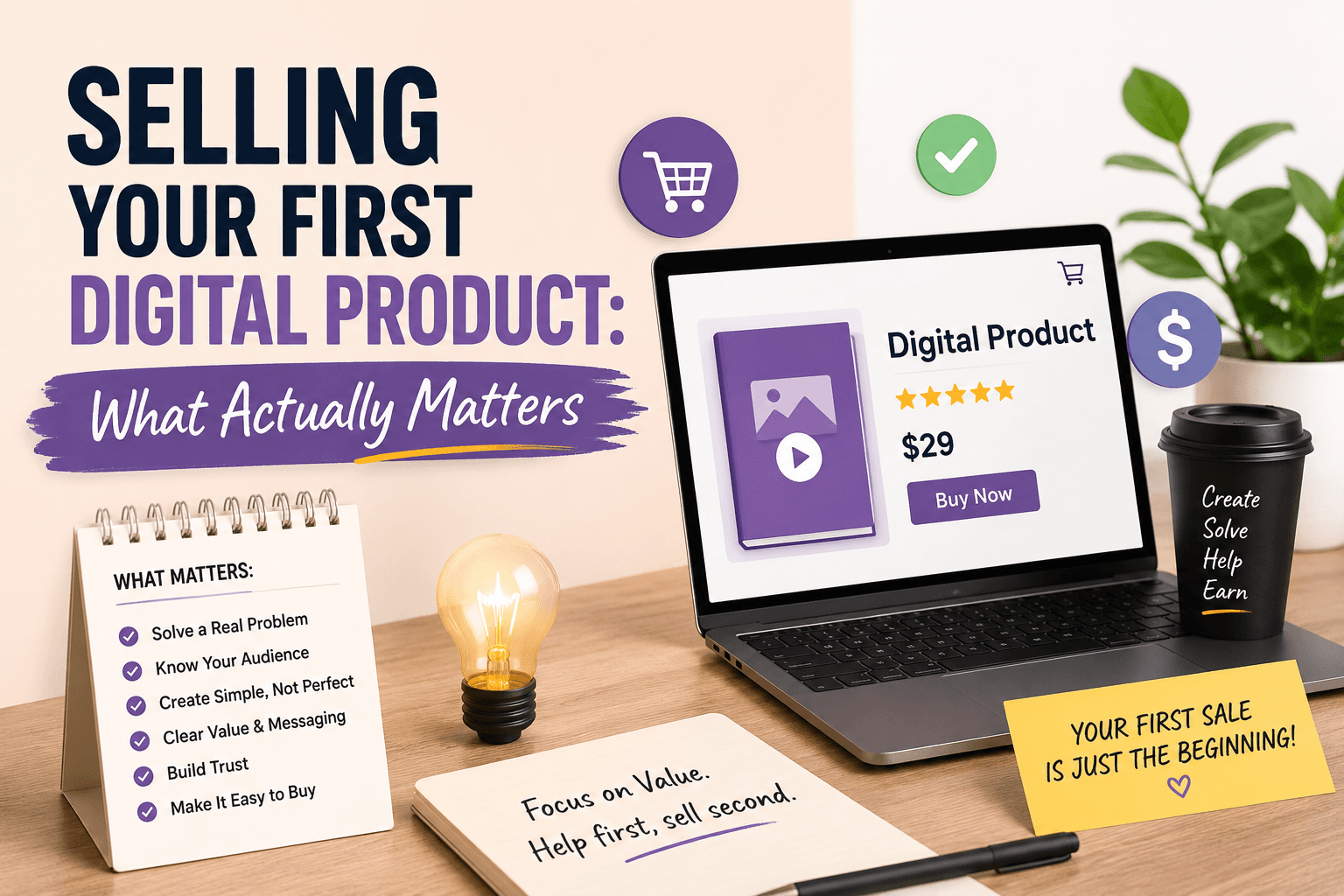
Templates, ebooks, courses, presets, planners, stock assets. Digital products are appealing because you build the thing once and can sell it many times. The build-once part is genuinely true. The "set it and forget it, money while you sleep" part is oversold, and going in expecting it leads to a lot of abandoned projects.
Here's a more grounded look at getting a first one out the door.
Sell help with a specific problem
The digital products that work solve a clear problem for a clearly defined person. "A budgeting spreadsheet" is vague. "A budgeting spreadsheet for freelancers with irregular monthly income" tells a specific person that it was made for them.
Start from something you already understand well enough to help with. What do people ask you about? What did you have to figure out the hard way that you could package for the next person? The narrower the focus, the easier it is to make and to market.
Check that people want it before you build it
The most common mistake is spending two months making something, then discovering nobody's looking for it.
- Talk to a handful of people in your target group and ask how they handle the problem now, and what they'd pay to handle it better.
- Look at whether similar products already sell. Some competition is a good sign; it means there's a market.
- Try pre-selling. Describe the product, put up a way to buy it, and see if anyone does before you've finished making it. A few real orders tell you more than a hundred people saying "sounds great."
Start small
A focused $15 template that you actually finish and list beats a sprawling course you're still editing six months later. A small first product lets you learn how selling works, get real feedback, and build a bit of an audience, all of which make the next, bigger product easier.
You can always expand a simple product later, or bundle several small ones.
Decide where to sell it
Your own site means you keep more of each sale, you own the customer relationship and their email address, and you control the presentation. The trade-off is that you're responsible for bringing every visitor.
A marketplace brings its own traffic of people already looking to buy, and handles payment and delivery. In exchange it takes a cut, limits how you present things, and usually keeps the customer relationship for itself.
Plenty of people do both: a marketplace for discovery, their own store for the main catalogue and repeat buyers.
Don't race to the bottom on price
Digital doesn't have to mean cheap. Price reflects the value of the outcome and the time it saves the buyer, not the fact that the file costs nothing to copy. Underpricing can even work against you, since a very low price makes some buyers assume the product is thin. Look at what comparable products charge and position yourself deliberately within that range.
Expect the unglamorous parts
Selling anything, digital included, comes with maintenance:
- Customer questions and the occasional confused buyer who needs help downloading.
- Refund requests. Have a clear policy and stick to it.
- Updates when a tool the product depends on changes, or when you spot an error.
- Some amount of unauthorised sharing. Chasing it aggressively usually costs more energy than it's worth; factor a bit of leakage in and move on.
Marketing doesn't stop at launch
A digital product doesn't sell itself just because it exists. Ongoing, low-key promotion is part of the deal: useful content related to the problem it solves, an email list you actually write to, showing the product in use, answering questions in places your buyers gather. Launch traffic fades quickly; the steady trickle comes from being consistently visible.
Improve it based on what you hear
Early buyers will tell you what's confusing, what's missing, and what they expected but didn't get. Reviews do the same in public. Fold that feedback into updates. A product that gets a little better with each version, and whose buyers feel heard, builds the kind of reputation that makes future products easier to sell.
Be realistic about the money
Some digital products earn a meaningful income. Many earn a modest side amount, and plenty earn very little, usually because the audience was too small or the problem too niche. Treat the first one as a paid education in how this works rather than a finished income stream, and judge whether to keep going based on real numbers.
Takeaway
Pick a specific problem you can genuinely help with, confirm people want the solution before you build it, start with something small enough to actually finish, and price it for the value it delivers. Then keep showing up to market it, because that part doesn't end at launch.